
THE GEMHOOD EDITORIAL LIBRARY
Scolecite gemstone guide
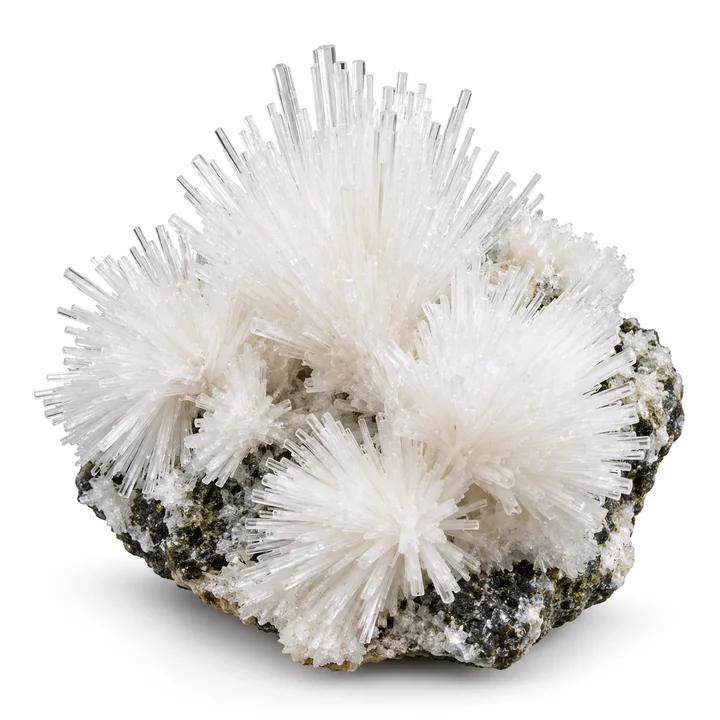
Scolecite commonly grows as slender white needles and radiating sprays that form striking flower-like clusters on host rock. Such fragile mineral specimens are normally collected and displayed rather than worn; individual crystal sprays can chip or separate during handling.
Gem facts · Quality considerations · Care & meaning
 A study in colour and character
Every shade has a story.
Typical appearances for Scolecite. Natural stones vary, and lighting or treatment can change their appearance.
Where Scolecite is found
India; Iceland
 India
India
 Iceland
These are representative geological or commercial sources, not certified provenance for an individual stone. Country of origin should be substantiated independently when relevant to value.
What is Scolecite?
Scolecite is included in the GEMHOOD mineral and gemstone encyclopedia as an educational guide to its visual characteristics, durability and care. Scolecite commonly grows as slender white needles and radiating sprays that form striking flower-like clusters on host rock. Such fragile mineral specimens are normally collected and displayed rather than worn; individual crystal sprays can chip or separate during handling. Typical observed colours include snow white, colourless and creamy white. Mohs hardness is approximately 5–5.5; this measures resistance to scratching, not toughness, cleavage or chemical stability. Recorded mineral localities include India, Iceland; these are examples of occurrence, not proof of where a particular stone originated. Inspect whether fine needles remain intact and verify specimen labelling, rather than mistaking other white zeolite clusters for scolecite. Use a soft dry brush for loose dust; avoid immersion, strong cleaning products, ultrasonic devices and pressure on needle clusters. Gemstone illustrations on this page are digitally generated and must not be used to authenticate mineral identity or individual provenance.
History and cultural context
Scolecite is represented in GemHood as a distinct mineral or named gem variety, with typical appearances and mineral source localities rather than verified individual specimen origins. Scolecite commonly grows as slender white needles and radiating sprays that form striking flower-like clusters on host rock. Such fragile mineral specimens are normally collected and displayed rather than worn; individual crystal sprays can chip or separate during handling.
Colour and appearance
Snow white, colourless and creamy white
Jewellery suitability
Inspect whether fine needles remain intact and verify specimen labelling, rather than mistaking other white zeolite clusters for scolecite.
Caring for Scolecite
Use a soft dry brush for loose dust; avoid immersion, strong cleaning products, ultrasonic devices and pressure on needle clusters.
Cleaning guidance
Use a soft dry brush for loose dust; avoid immersion, strong cleaning products, ultrasonic devices and pressure on needle clusters.
No matching jewellery is currently in stock. Explore the guide or browse our full collection.
Browse jewellery →KEEP EXPLORING
Other gemstones to discover
Educational articles describe gemstone types and common trade practices. They are not individual gemological certificates, current price appraisals or medical advice.