
THE GEMHOOD EDITORIAL LIBRARY
Astrophyllite gemstone guide
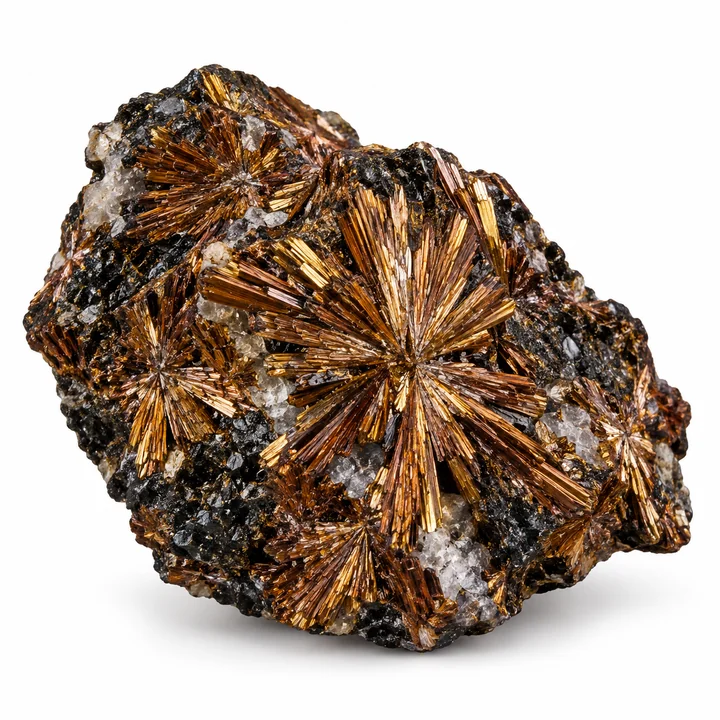
Golden-brown, starburst-shaped bladed crystals in darker rock make astrophyllite visually distinctive. It is a collector mineral often polished with its host rock rather than set as a durable transparent gem.
Gem facts · Quality considerations · Care & meaning
 A study in colour and character
Every shade has a story.
Typical appearances for Astrophyllite. Natural stones vary, and lighting or treatment can change their appearance.
Where Astrophyllite is found
Norway; Russia; Canada; United States
 Norway
 Russia
 Canada
 United States
How it forms
Typically associated with agpaitic alkaline igneous complexes, nepheline syenites and their pegmatites
These are representative geological or commercial sources, not certified provenance for an individual stone. Country of origin should be substantiated independently when relevant to value.
01 / THE GEM AT A GLANCE
What is Astrophyllite?
Astrophyllite is a naturally occurring titanium–iron sheet/chain silicate represented by K₂NaFe²⁺₇Ti₂(Si₄O₁₂)₂O₂(OH)₄F, with a reported Mohs hardness of 3. It commonly appears as Thin bronzy, micaceous blade-like crystals spread in starbursts across a dark contrasting host rock. Its documented colours include Bronze yellow, golden brown, reddish brown. Typically associated with agpaitic alkaline igneous complexes, nepheline syenites and their pegmatites.
Astrophyllite is included in the GEMHOOD mineral and gemstone encyclopedia as an educational guide to its visual characteristics, durability and care. Golden-brown, starburst-shaped bladed crystals in darker rock make astrophyllite visually distinctive. It is a collector mineral often polished with its host rock rather than set as a durable transparent gem. Typical observed colours include bronze-gold, copper and brown. Mohs hardness is approximately 3; this measures resistance to scratching, not toughness, cleavage or chemical stability. Recorded mineral localities include Norway, Russia; these are examples of occurrence, not proof of where a particular stone originated. Check whether the labelled material is astrophyllite itself or a composite stone containing other mineral inclusions. Avoid abrasives, ultrasonic cleaning and prolonged soaking; dust and wipe gently with a dry soft cloth. Gemstone illustrations on this page are digitally generated and must not be used to authenticate mineral identity or individual provenance.
02 / LOOK CLOSER
Colour, appearance and quality
Typical specimen appearance: Thin bronzy, micaceous blade-like crystals spread in starbursts across a dark contrasting host rock. Reported reference localities include Norway; Russia; Canada; United States. These are general occurrence areas, not proof of origin for any photographed or offered specimen.
Before you choose a stone
Compare images taken in more than one lighting condition, ask for views of the actual item and check how the cut and setting change its appearance. A gemstone type is not a standard grade: each natural specimen has its own colour, inclusions and workmanship.
THE GEMHOOD BUYER'S FIELD NOTES
How to choose Astrophyllite: three checks
- 01
The characteristic radial bronze-blade habit is a useful clue, but sparkling golden needles or flakes may also be micas or unrelated minerals; identity is best based on verified locality plus testing.
- 02
Check condition, actual photos, species and locality documentation, measurements and any treatment. In polished rock, radiating gold-coloured bands can include multiple minerals; do not assume a polished slab is pure astrophyllite.
Brittle, flaking specimens shed small fragments. Keep flakes away from children and pets; avoid crushing and inhaling dust.
At Mohs 3 and with conspicuous cleavage, astrophyllite is best for protected mineral displays or enclosed decorative objects, not rings.
These notes describe typical gem material and trade practices. They do not independently grade or identify a specific item offered for sale.
03 / BUY WITH CONFIDENCE
Natural, laboratory-grown, treated or imitation?
The characteristic radial bronze-blade habit is a useful clue, but sparkling golden needles or flakes may also be micas or unrelated minerals; identity is best based on verified locality plus testing. In polished rock, radiating gold-coloured bands can include multiple minerals; do not assume a polished slab is pure astrophyllite. Require photographs of the exact object, scale, an accurate species label, evidence of any claimed locality, and disclosure of treatment, repairs and synthetic or coated substitutes.
These distinctions should be clear in the listing for any particular gem. Treatments are not automatically unacceptable, but an undisclosed treatment, vague mineral identity or unsupported origin claim prevents an informed purchase. Where material identity materially affects value, an independent gemological identification report may be worth considering.
A CLOSER LOOK
Composition, hardness and crystal science
Astrophyllite is a naturally occurring titanium–iron sheet/chain silicate represented by K₂NaFe²⁺₇Ti₂(Si₄O₁₂)₂O₂(OH)₄F, with a reported Mohs hardness of 3. It commonly appears as Thin bronzy, micaceous blade-like crystals spread in starbursts across a dark contrasting host rock. Its documented colours include Bronze yellow, golden brown, reddish brown. Typically associated with agpaitic alkaline igneous complexes, nepheline syenites and their pegmatites.
The formula K₂NaFe²⁺₇Ti₂(Si₄O₁₂)₂O₂(OH)₄F is representative, and impurities or compositional substitution may vary with the geological occurrence. A Mohs rating of 3 measures scratch resistance only; inspect cleavage, crystal terminations and mechanical fragility separately.
A CLOSER LOOK
Appearance, colour and typical crystal habit
Astrophyllite is described by Thin bronzy, micaceous blade-like crystals spread in starbursts across a dark contrasting host rock. Reported colours include Bronze yellow, golden brown, reddish brown.
The characteristic radial bronze-blade habit is a useful clue, but sparkling golden needles or flakes may also be micas or unrelated minerals; identity is best based on verified locality plus testing. In polished rock, radiating gold-coloured bands can include multiple minerals; do not assume a polished slab is pure astrophyllite. Require photographs of the exact object, scale, an accurate species label, evidence of any claimed locality, and disclosure of treatment, repairs and synthetic or coated substitutes.
A CLOSER LOOK
Geological formation and host-rock setting
Typically associated with agpaitic alkaline igneous complexes, nepheline syenites and their pegmatites
Reference occurrence areas: Norway; Russia; Canada; United States. Reported reference localities, not independently verified provenance for a listed product. A location on a generic educational page is not the same as a documented specimen chain of custody.
A CLOSER LOOK
History, nomenclature and frequently mistaken species
Its name combines Greek words meaning star and leaf, referring to radiating, leaf-like crystals.
In polished rock, radiating gold-coloured bands can include multiple minerals; do not assume a polished slab is pure astrophyllite.
Compare visually similar materials such as aegirine; biotite; phlogopite. A visual match is only a starting point, not mineralogical authentication.
A CLOSER LOOK
Identification and trustworthy mineral buying
The characteristic radial bronze-blade habit is a useful clue, but sparkling golden needles or flakes may also be micas or unrelated minerals; identity is best based on verified locality plus testing. In polished rock, radiating gold-coloured bands can include multiple minerals; do not assume a polished slab is pure astrophyllite. Require photographs of the exact object, scale, an accurate species label, evidence of any claimed locality, and disclosure of treatment, repairs and synthetic or coated substitutes.
Ask for actual measured dimensions and multiple current photos; confirm any restoration, colouring, backing, polished surface or matrix attachment. For expensive material, request a trusted independent opinion rather than relying on promotional images.
A CLOSER LOOK
Collection display and suitability for jewellery
At Mohs 3 and with conspicuous cleavage, astrophyllite is best for protected mineral displays or enclosed decorative objects, not rings. The GemHood picture is a generated educational illustration; it is not an authenticated specimen, laboratory result or sale item.
Transport specimens in individual padded boxes; support loose blades, fans or plates from beneath their host matrix, and never rely solely on the Mohs rating to decide how the specimen should be worn.
A CLOSER LOOK
Cleaning, stability and collector safety
Brittle, flaking specimens shed small fragments. Keep flakes away from children and pets; avoid crushing and inhaling dust. Do not scrub or soak thin radial sprays. Use a cool, dry display position, soft dusting brush and padded storage to prevent blade breakage.
Use the least aggressive cleaning method that preserves the species and any associated matrix. Avoid ultrasonic and steam cleaning for fragile, altered, repaired or unknown specimens; wash hands after handling mineral dust or metal-bearing samples.
A CLOSER LOOK
Understanding the GemHood mineral illustration
The illustration is intended to suggest Coppery-bronze starburst fans resting on a dark matrix; individual sprays may be fragile.
This is an original educational depiction, not an authenticated specimen photograph, lab finding or purchasable product. Natural examples differ substantially in shape and colour; do not use the illustration to establish species, treatment or provenance.
04 / WEAR IT WELL
Astrophyllite in jewellery
At Mohs 3 and with conspicuous cleavage, astrophyllite is best for protected mineral displays or enclosed decorative objects, not rings. The GemHood picture is a generated educational illustration; it is not an authenticated specimen, laboratory result or sale item.
05 / MAKE IT LAST
How to care for Astrophyllite
Brittle, flaking specimens shed small fragments. Keep flakes away from children and pets; avoid crushing and inhaling dust. Do not scrub or soak thin radial sprays. Use a cool, dry display position, soft dusting brush and padded storage to prevent blade breakage.
One essential care distinction
Mohs hardness describes resistance to scratching, not resistance to breaking. Gemstones with cleavage, existing fractures, porous surfaces or fillings can need extra care regardless of their hardness number. If you do not know whether a piece has been treated, begin with the gentlest appropriate cleaning method.
06 / CULTURE & MEANING
History, heritage and symbolism
Its name combines Greek words meaning star and leaf, referring to radiating, leaf-like crystals.
Astrophyllite is represented in GemHood as a distinct mineral or named gem variety, with typical appearances and mineral source localities rather than verified individual specimen origins. Golden-brown, starburst-shaped bladed crystals in darker rock make astrophyllite visually distinctive. It is a collector mineral often polished with its host rock rather than set as a durable transparent gem.
Traditional meanings and spiritual associations are part of cultural storytelling. They are not evidence that a gemstone diagnoses, prevents or treats any medical condition.
GOOD QUESTIONS, CLEAR ANSWERS
Astrophyllite FAQs
What is Astrophyllite?
Astrophyllite is a titanium–iron sheet/chain silicate, commonly represented by K₂NaFe²⁺₇Ti₂(Si₄O₁₂)₂O₂(OH)₄F. Typical appearance includes Thin bronzy, micaceous blade-like crystals spread in starbursts across a dark contrasting host rock.
How hard is Astrophyllite?
A typical reported Mohs hardness is 3. Scratching resistance does not measure toughness, cleavage, safety or suitability for everyday wear.
What colour is natural Astrophyllite?
Reported colours include Bronze yellow, golden brown, reddish brown. Lighting, matrix, mineral impurities and display settings can affect perceived colour.
Where does Astrophyllite form?
Typically associated with agpaitic alkaline igneous complexes, nepheline syenites and their pegmatites Published occurrence areas include Norway; Russia; Canada; United States, but these do not establish a sale item’s actual origin.
How can I identify Astrophyllite?
The characteristic radial bronze-blade habit is a useful clue, but sparkling golden needles or flakes may also be micas or unrelated minerals; identity is best based on verified locality plus testing. A mineral specialist may need to examine the particular specimen.
Can Astrophyllite be used for jewellery?
At Mohs 3 and with conspicuous cleavage, astrophyllite is best for protected mineral displays or enclosed decorative objects, not rings.
How should I clean Astrophyllite?
Do not scrub or soak thin radial sprays. Use a cool, dry display position, soft dusting brush and padded storage to prevent blade breakage.
Is Astrophyllite safe to handle?
Brittle, flaking specimens shed small fragments. Keep flakes away from children and pets; avoid crushing and inhaling dust.
Is the GemHood Astrophyllite picture a real specimen?
No. It is an original generated educational illustration designed around typical Astrophyllite appearances. It is not a certified specimen photo, laboratory determination or a product for sale.
Which minerals can be confused with Astrophyllite?
Possible lookalikes include aegirine; biotite; phlogopite. In polished rock, radiating gold-coloured bands can include multiple minerals; do not assume a polished slab is pure astrophyllite.
A NOTE FROM THE GEMHOOD EDITORIAL DESK
How to use this guide
We explain gemstone properties, known mining regions and customary treatments to help you shop more confidently. Each gemstone can vary in quality and individual provenance, so compare the actual jewellery listing and request supporting documentation if origin, treatment or natural-versus-laboratory-grown status affects your choice.
Our gemstone library is educational and does not act as a laboratory identification certificate. Independent gemological assessment is advisable for valuable or disputed claims.
EDITORIAL REFERENCES
Research and further reading
References describe mineral species and representative occurrences, not verification of any individual item for sale.
No matching jewellery is currently in stock. Explore the guide or browse our full collection.
Browse jewellery →UNDERSTAND THE DIFFERENCE
Compare Astrophyllite with similar gemstones
These stones can overlap in colour, appearance or jewellery use. The mineral identity, treatments and durability may be very different.
KEEP EXPLORING
Other gemstones to discover
Educational articles describe gemstone types and common trade practices. They are not individual gemological certificates, current price appraisals or medical advice.